Quiz Answers with Explanations
A free, printable general worksheet ready for your classroom. Download instantly, print, and hand out to your students — no account needed.
Quiz Answers with Explanations

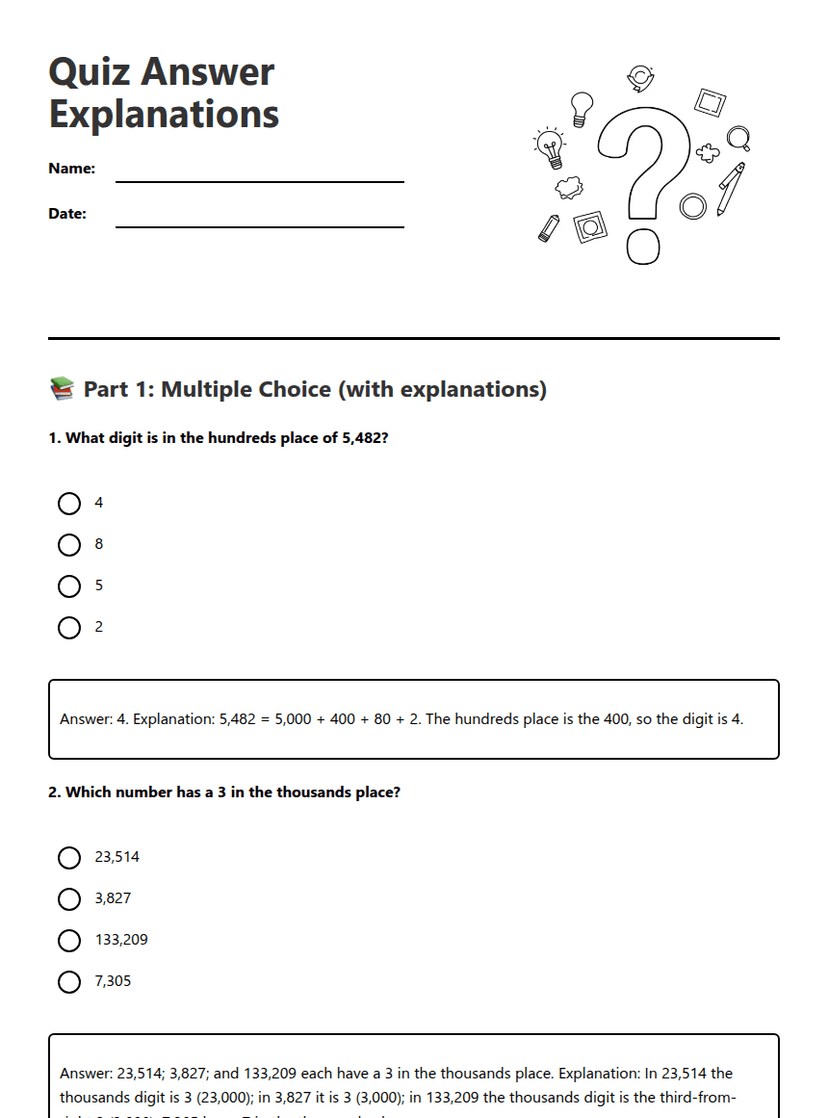
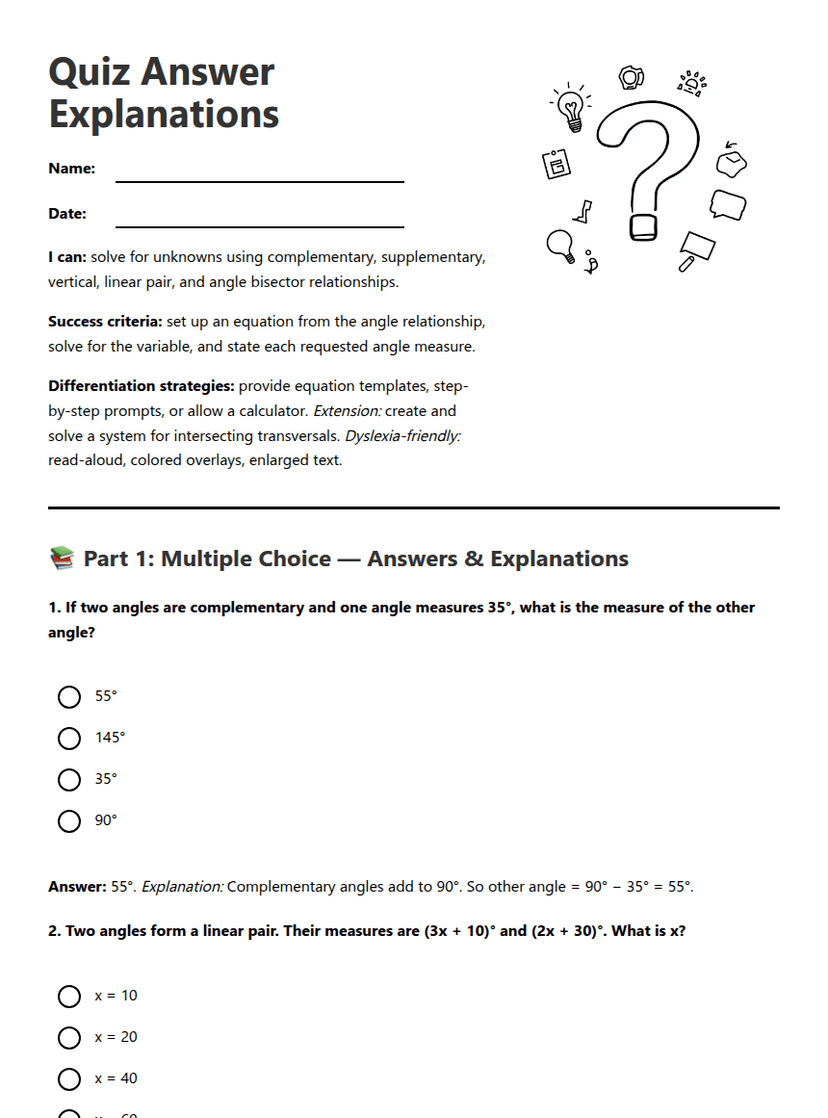
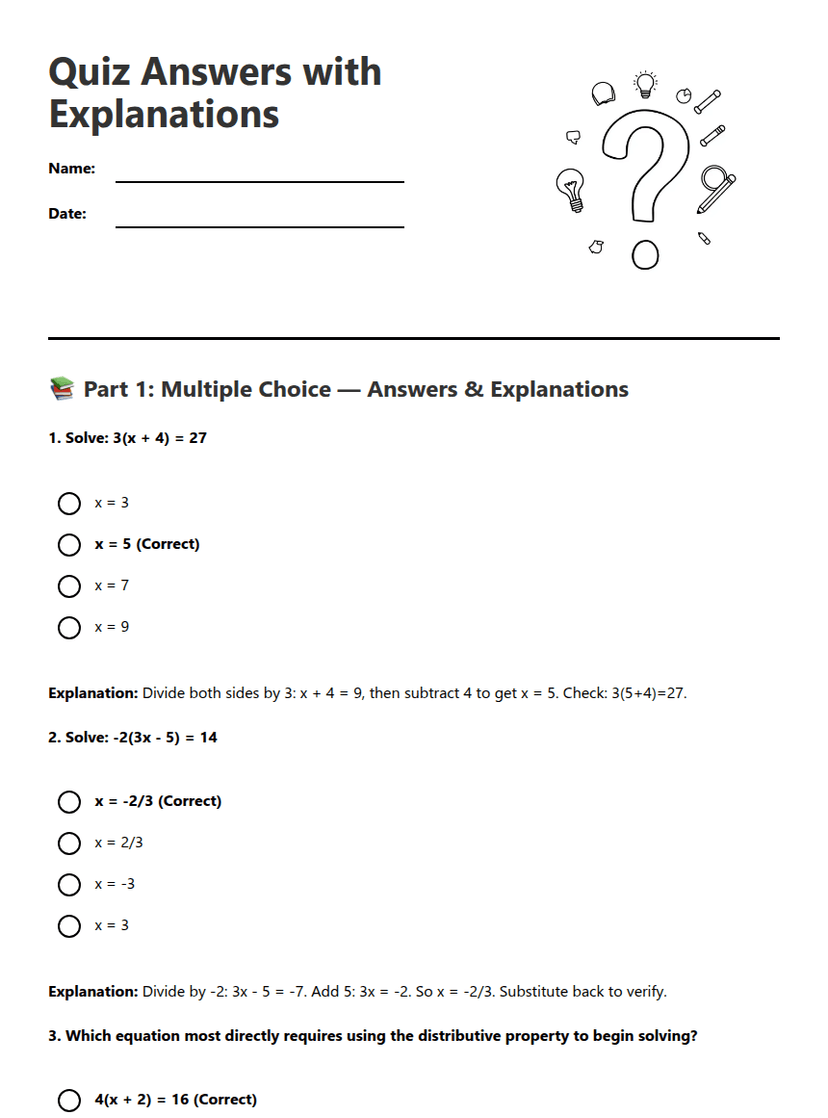
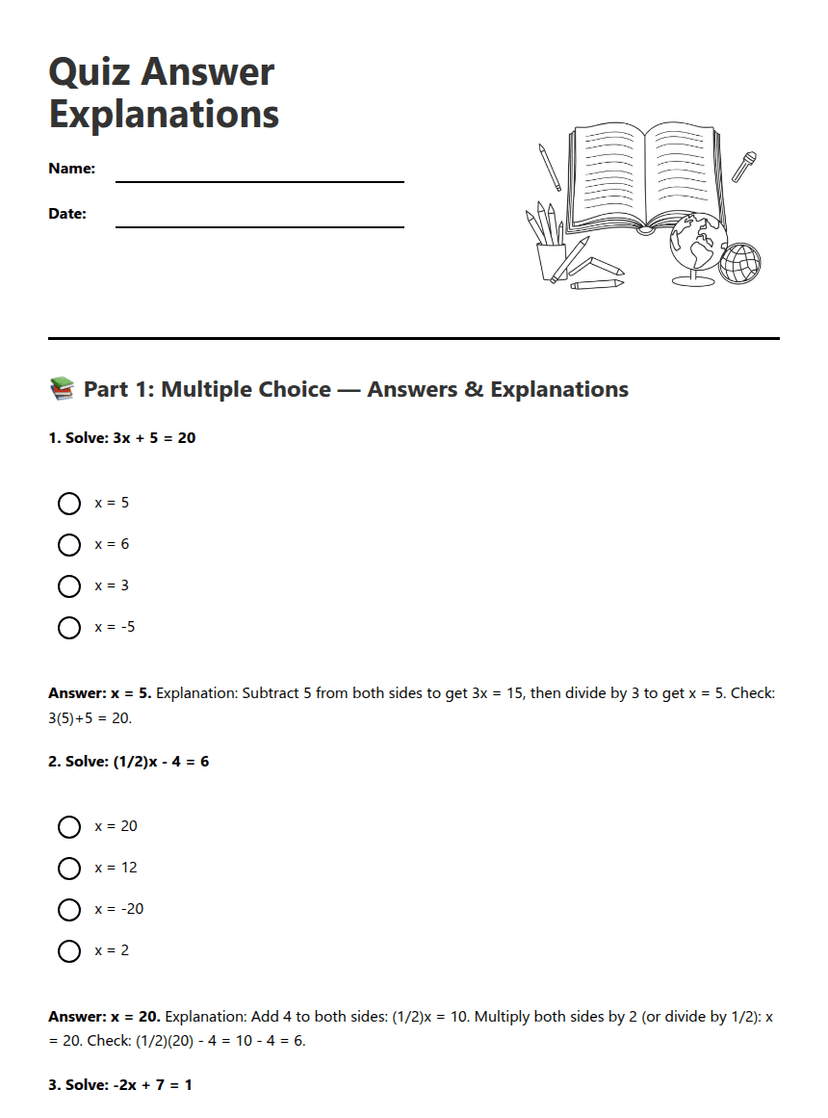
📚 Part 1: Multiple Choice — Answers & Explanations
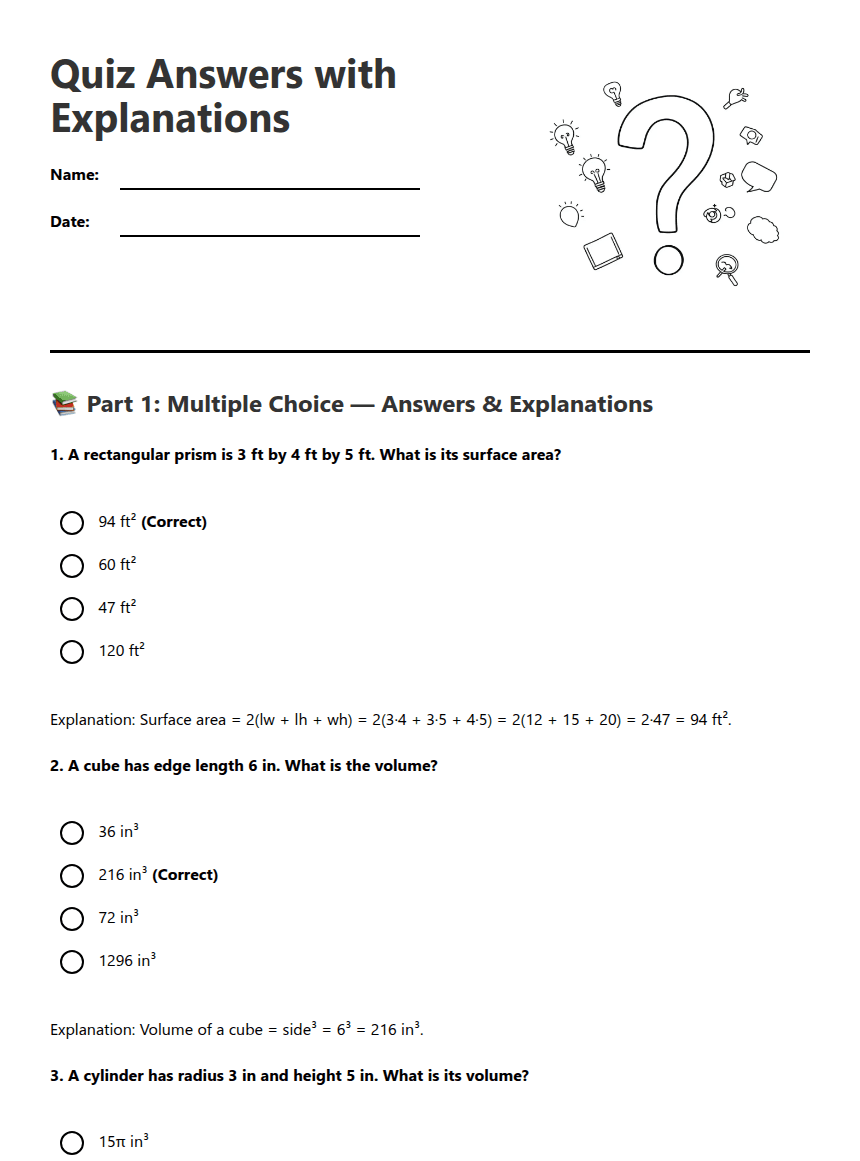
Explanation: Surface area = 2(lw + lh + wh) = 2(3·4 + 3·5 + 4·5) = 2(12 + 15 + 20) = 2·47 = 94 ft².
Explanation: Volume of a cube = side³ = 6³ = 216 in³.
Explanation: Volume = πr²h = π·3²·5 = π·9·5 = 45π in³ (≈ 141.37 in³).
Explanation: Total surface area = area of two bases (2πr²) + lateral area (2πrh) = 2πr² + 2πrh.
✏️ Part 2: Short Answers — Answers & Explanations
🔎 Lesson Goals, Success Criteria & Supports
I can... solve routine problems involving surface area and volume of prisms, cylinders, spheres, and cubes.
Success criteria: I can choose and apply the correct formula, show units (in² or in³), and explain each calculation step.
Differentiation strategies: For learners who need support, provide step-by-step templates and worked examples; use manipulatives or labeled diagrams; allow calculators for arithmetic. For learners who need challenge, give multi-step problems combining surface area and volume, or ask for proofs about scaling.
Extension activities: Compare how surface area and volume change under different scale factors; design a real-world container minimizing material for a given volume.
Dyslexia-friendly reading options: Provide printed copies with increased spacing, sans-serif fonts, colored overlays if helpful, and audio recordings of the problems. Keep language simple and break explanations into short lines.
About This Worksheet
Free Download
No sign-up, no email, no paywall. Just download and print.
Print-Ready
Formatted for standard paper. Clean layout, easy to read.
AI-Generated
Created with Kuraplan's AI, designed for real classroom use.
For Teachers & Parents
Use in classrooms, for homework, tutoring, or homeschool.
Need a custom version of this worksheet?
Kuraplan's AI generates custom worksheets in seconds — differentiated for every learner, aligned to your curriculum.
Generate Custom Worksheets — Free