Quiz Answer Explanations
A free, printable general worksheet ready for your classroom. Download instantly, print, and hand out to your students — no account needed.
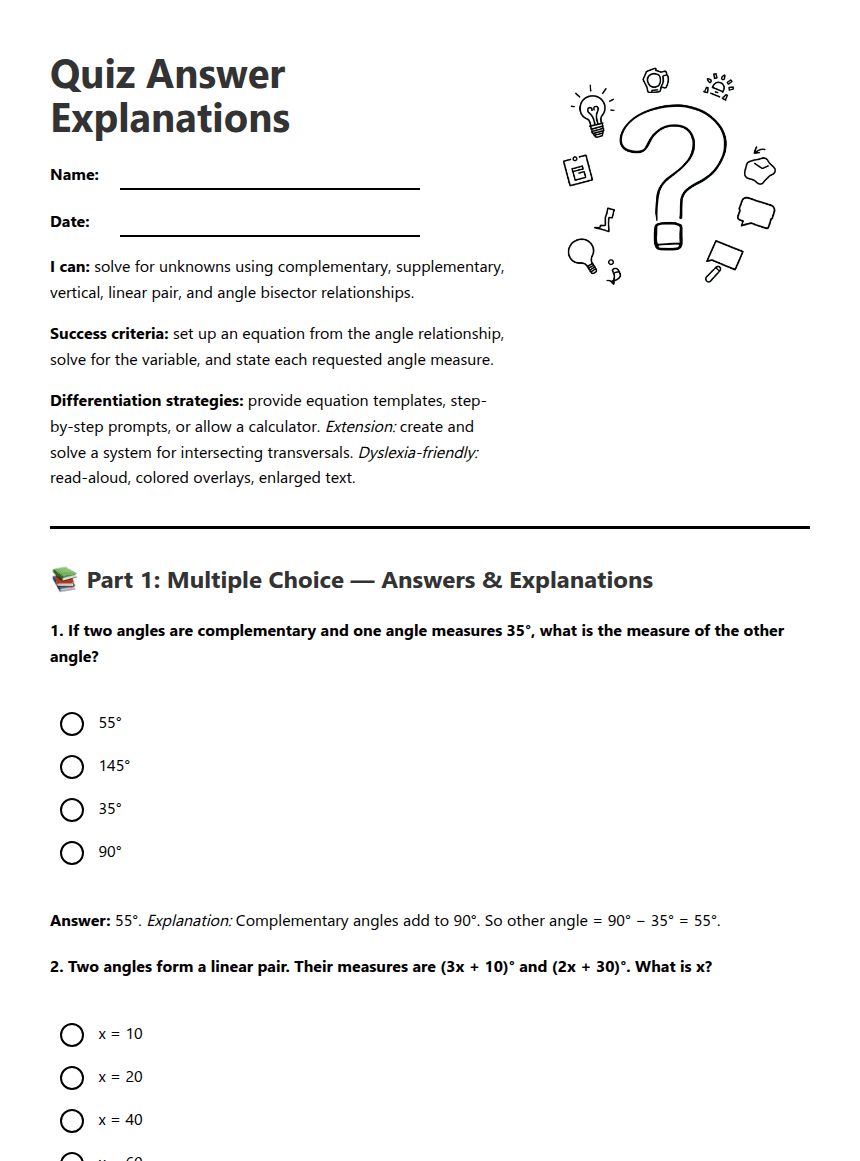
Quiz Answer Explanations
I can: solve for unknowns using complementary, supplementary, vertical, linear pair, and angle bisector relationships.
Success criteria: set up an equation from the angle relationship, solve for the variable, and state each requested angle measure.
Differentiation strategies: provide equation templates, step-by-step prompts, or allow a calculator. Extension: create and solve a system for intersecting transversals. Dyslexia-friendly: read-aloud, colored overlays, enlarged text.

📚 Part 1: Multiple Choice — Answers & Explanations
Answer: 55°. Explanation: Complementary angles add to 90°. So other angle = 90° − 35° = 55°.
Answer: x = 28. Explanation: Linear pair angles are supplementary: (3x+10)+(2x+30)=180 → 5x+40=180 → 5x=140 → x=28.
Answer: y = 10. Explanation: Vertical angles are congruent: 4y+5 = 2y+25 → 2y = 20 → y = 10.
Answers: "They are congruent" and "They share a common vertex but not a common side." Explanation: Vertical angles are equal and meet at the same vertex; they are not adjacent (they do not share a side) and do not necessarily add to 180°.
✏️ Part 2: Short Answers — Work & Explanations
Set sum = 180: (5x+10)+(2x+40)=180
7x + 50 = 180 → 7x = 130 → x = 130/7
Angle 1 = 5x+10 = 5*(130/7)+10 = 650/7 + 10 = 720/7 ≈ 102.857°
Angle 2 = 2x+40 = 2*(130/7)+40 = 260/7 + 40 = 540/7 ≈ 77.143°
Explanation: The two angles sum to 180°, solve for x, then substitute to get each measure (exact fractions shown).
Bisected means each piece = half the whole: 2*(2x+5) = 3x+20
4x + 10 = 3x + 20 → x = 10
Whole angle = 3x+20 = 3(10)+20 = 50°; each = 2(10)+5 = 25°
Explanation: Doubling a bisected piece equals the whole; solve and substitute.
Vertical angles are equal: 6x − 12 = 3x + 30
3x = 42 → x = 14
Each angle = 6(14) − 12 = 84 − 12 = 72°
Explanation: Set the expressions equal (vertical angles are congruent) and solve.
They sum to 90: (x+12)+(2x−8)=90
3x + 4 = 90 → 3x = 86 → x = 86/3
Angle 1 = x+12 = 86/3 + 12 = 122/3 ≈ 40.667°
Angle 2 = 2x−8 = 2*(86/3) − 8 = 148/3 ≈ 49.333°
Explanation: Adjacent angles that form a right angle sum to 90°; solve then compute each measure (exact fractions given).
Angles on a straight line are supplementary: (4x+15)+(3x+30)=180
7x + 45 = 180 → 7x = 135 → x = 135/7
Angle 1 = 4x+15 = 4*(135/7)+15 = 645/7 ≈ 92.143°
Angle 2 = 3x+30 = 3*(135/7)+30 = 615/7 ≈ 87.857°
Explanation: Supplementary angles along a straight line add to 180°; solve for x and substitute for each measure.
About This Worksheet
Free Download
No sign-up, no email, no paywall. Just download and print.
Print-Ready
Formatted for standard paper. Clean layout, easy to read.
AI-Generated
Created with Kuraplan's AI, designed for real classroom use.
For Teachers & Parents
Use in classrooms, for homework, tutoring, or homeschool.
Need a custom version of this worksheet?
Kuraplan's AI generates custom worksheets in seconds — differentiated for every learner, aligned to your curriculum.
Generate Custom Worksheets — Free