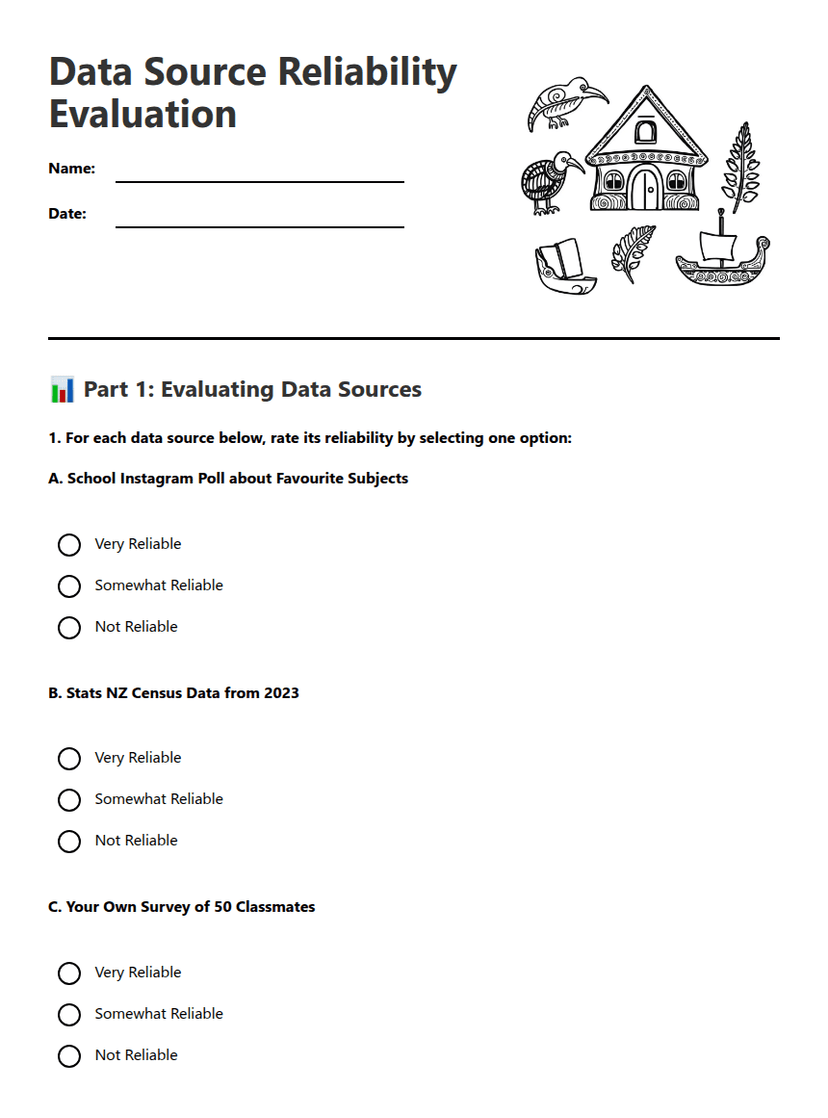
Data Source Reliability Assessment
A free, printable general worksheet ready for your classroom. Download instantly, print, and hand out to your students — no account needed.
Data Source Reliability Assessment
🔍 Part 1: Data Source Detective
Instructions: Read each data source below and rate its reliability on a scale of 1-5 (1 = Very Unreliable, 5 = Very Reliable). Circle your rating and identify if it's primary or secondary data.
Reliability Rating: 1 - 2 - 3 - 4 - 5
This is _____________ data (primary/secondary)
Reliability Rating: 1 - 2 - 3 - 4 - 5
This is _____________ data (primary/secondary)
Reliability Rating: 1 - 2 - 3 - 4 - 5
This is _____________ data (primary/secondary)
Reliability Rating: 1 - 2 - 3 - 4 - 5
This is _____________ data (primary/secondary)
Reliability Rating: 1 - 2 - 3 - 4 - 5
This is _____________ data (primary/secondary)
✅ Part 2: Data Quality Checklist
Primary data collection method:
Secondary data source:
🎯 Part 3: Extension Challenge
Success Criteria:
- I can distinguish between primary and secondary data sources
- I can evaluate the reliability of different data sources using appropriate criteria
- I can identify factors that make data sources more or less trustworthy
- I can design methods for collecting reliable data
ANSWER KEY
Part 1 - Data Source Detective:
1. Source A: Reliability 5, Secondary data (collected by Stats NZ, not by you)
2. Source B: Reliability 1, Secondary data (unreliable - no evidence or methodology)
3. Source C: Reliability 4-5, Primary data (you collected it yourself)
4. Source D: Reliability 2, Secondary data (outdated and second-hand information)
5. Source E: Reliability 5, Secondary data (official government data with methodology)
Part 2 - Data Quality Checklist:
6. All boxes should be checked - these are all important factors
7. Sample answers: Larger samples are more representative of the population and reduce the impact of outliers. Example: Surveying 5 students vs 500 students about study habits.
8. Primary: Survey Year 11 students directly; Secondary: Use existing research studies or government reports on teenage social media use
Part 3 - Extension:
9. Sample answer for Source B: Survey a random sample of at least 200 teenagers using standardised questions, ensure anonymous responses, use multiple schools to avoid bias
10. Sample answer: Different time periods, different populations, different methodologies can all lead to different but valid results
About This Worksheet
Free Download
No sign-up, no email, no paywall. Just download and print.
Print-Ready
Formatted for standard paper. Clean layout, easy to read.
AI-Generated
Created with Kuraplan's AI, designed for real classroom use.
For Teachers & Parents
Use in classrooms, for homework, tutoring, or homeschool.
Need a custom version of this worksheet?
Kuraplan's AI generates custom worksheets in seconds — differentiated for every learner, aligned to your curriculum.
Generate Custom Worksheets — Free