FreePrintable
Conservation of Mass
A free, printable general worksheet ready for your classroom. Download instantly, print, and hand out to your students — no account needed.
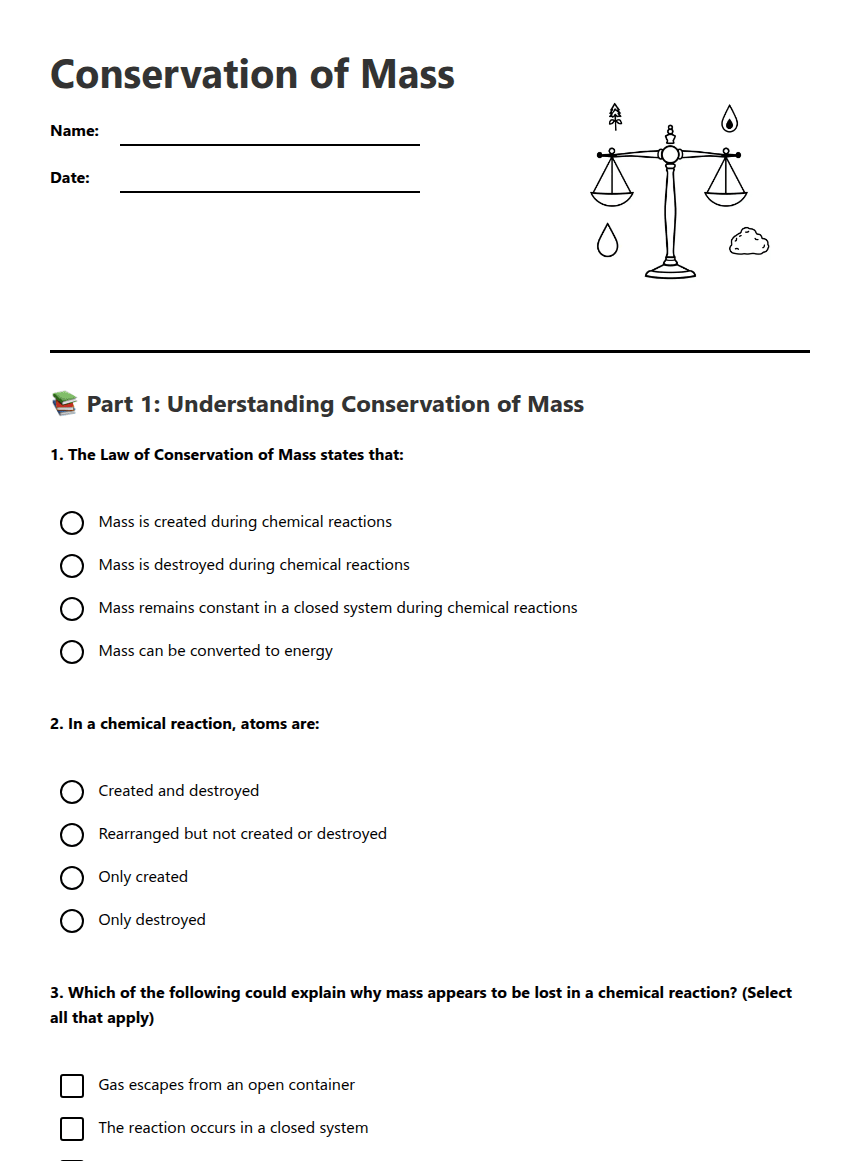
Conservation of Mass

📚 Part 1: Understanding Conservation of Mass
1. The Law of Conservation of Mass states that:
Mass is created during chemical reactions
Mass is destroyed during chemical reactions
Mass remains constant in a closed system during chemical reactions
Mass can be converted to energy
2. In a chemical reaction, atoms are:
Created and destroyed
Rearranged but not created or destroyed
Only created
Only destroyed
3. Which of the following could explain why mass appears to be lost in a chemical reaction? (Select all that apply)
Gas escapes from an open container
The reaction occurs in a closed system
Measurement errors with the balance
Water vapour escapes during heating
4. A student mixes 5.0g of baking soda with 10.0g of vinegar in a sealed bag. According to the Law of Conservation of Mass, the total mass after the reaction should be:
Less than 15.0g
Exactly 15.0g
More than 15.0g
Cannot be determined
🔬 Part 2: Practical Investigation Analysis
5. Complete the data table from your vinegar and baking soda experiment:
Initial mass of baking soda: _________ g
Initial mass of vinegar: _________ g
Total initial mass: _________ g
Final mass of sealed bag and contents: _________ g
Difference in mass: _________ g
6. Explain what you observed during the reaction and how it demonstrates the Law of Conservation of Mass:
7. Why was it important to seal the bag during the experiment?
8. Extension: If this same reaction was carried out in an open beaker instead of a sealed bag, predict what would happen to the measured mass and explain why:
⚖️ Part 3: Real-World Applications
9. A piece of magnesium ribbon with a mass of 2.4g is burned in air. The white powder (magnesium oxide) produced has a mass of 4.0g. Explain how this result supports the Law of Conservation of Mass:
10. Fill in the blanks: In industrial chemical processes, understanding conservation of mass is important because it allows chemists to _____________ the amount of products that will be formed and ensures that _____________ are not wasted.
11. Challenge Question: In a combustion reaction, 12g of carbon reacts with 32g of oxygen to form carbon dioxide. Calculate the mass of carbon dioxide produced and explain your reasoning:
Show your working:
Answer: _________ g of carbon dioxide
Explanation:
About This Worksheet
Free Download
No sign-up, no email, no paywall. Just download and print.
Print-Ready
Formatted for standard paper. Clean layout, easy to read.
AI-Generated
Created with Kuraplan's AI, designed for real classroom use.
For Teachers & Parents
Use in classrooms, for homework, tutoring, or homeschool.
Need a custom version of this worksheet?
Kuraplan's AI generates custom worksheets in seconds — differentiated for every learner, aligned to your curriculum.
Generate Custom Worksheets — Free No credit card Curriculum-aligned Under 60 seconds