ScienceFreePrintable

Atomic Structure and Bonding

A free, printable science worksheet ready for your classroom. Download instantly, print, and hand out to your students — no account needed.
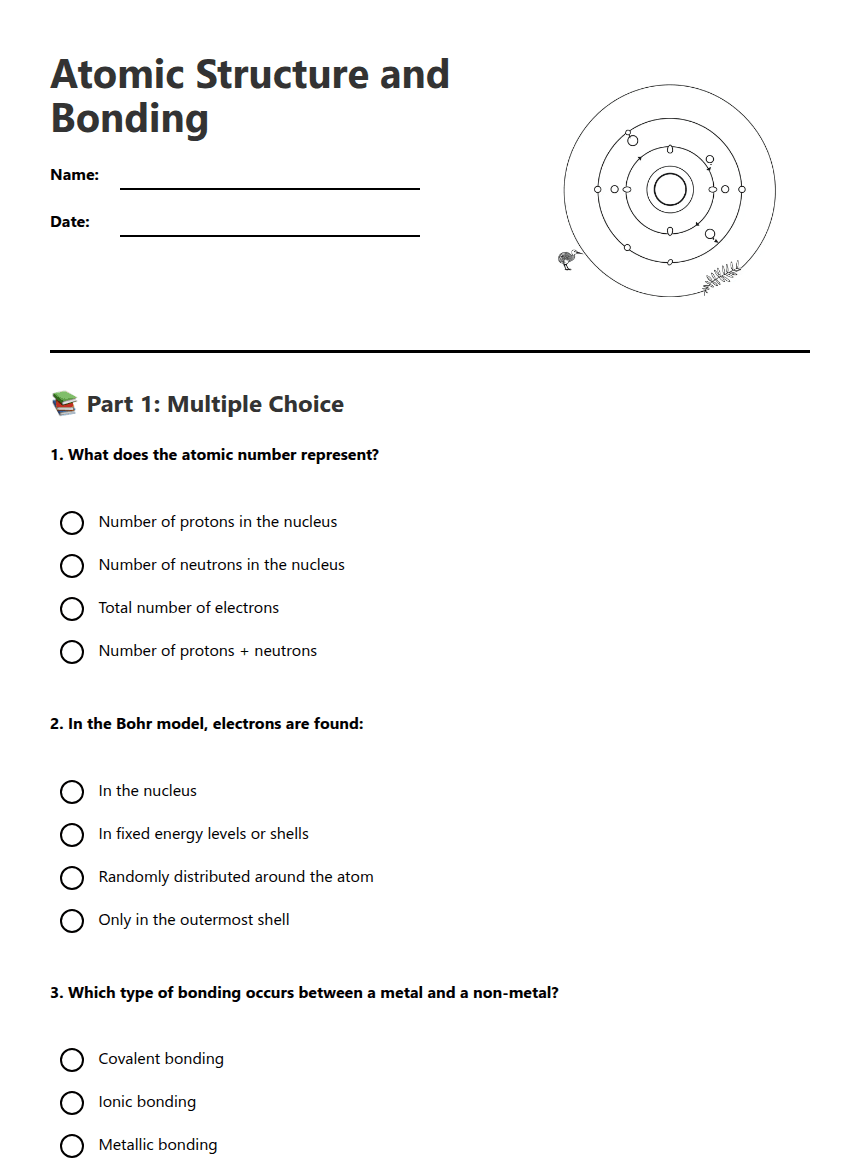
Atomic Structure and Bonding worksheet preview

Year 10 Science Assessment
                         Matter

Part 1: Multiple Choice

1. What does the atomic number represent?

Number of protons in the nucleus

Number of neutrons in the nucleus

Total number of electrons

Number of protons + neutrons

2. In the Bohr model, electrons are found:

In the nucleus

In fixed energy levels or shells

Randomly distributed around the atom

Only in the outermost shell

3. Which type of bonding occurs between a metal and a non-metal?

Covalent bonding

Ionic bonding

Metallic bonding

Hydrogen bonding

4. Which of the following are characteristics of covalent bonding? (Select all that apply)

Electrons are shared between atoms

Occurs between non-metals

Forms molecules

Electrons are transferred from one atom to another

 Part 2: Short Answer Questions

5. An atom has an atomic number of 17 and a mass number of 35. Calculate:

a) Number of protons: ___________

b) Number of electrons: ___________

c) Number of neutrons: ___________

6. Explain the difference between ionic and covalent bonding in terms of electron behaviour.
7. Draw the electron structure diagram (Bohr model) for a sodium atom (Na, atomic number = 11).
8. Complete the following table:

Element: Oxygen (O)

Atomic number: 8

Mass number: 16

Number of protons: ___________

Number of electrons: ___________

Number of neutrons: ___________

Electron configuration (shells): ___________

 Part 3: Application

9. Predict the type of bonding that would occur between the following pairs of elements and explain your reasoning:

a) Sodium (Na) and Chlorine (Cl): ________________________

b) Carbon (C) and Hydrogen (H): ________________________

10. Draw a simple diagram showing the formation of an ionic bond between sodium (Na) and fluorine (F). Show the electron transfer and the resulting ions.

About This Worksheet

Free Download

No sign-up, no email, no paywall. Just download and print.

Print-Ready

Formatted for standard paper. Clean layout, easy to read.

AI-Generated

Created with Kuraplan's AI, designed for real classroom use.

For Teachers & Parents

Use in classrooms, for homework, tutoring, or homeschool.

Need a custom version of this worksheet?

Kuraplan's AI generates custom worksheets in seconds — differentiated for every learner, aligned to your curriculum.

Generate Custom Worksheets — Free
No credit card Curriculum-aligned Under 60 seconds