Survival Structures Answer Key
A free science worksheet ready for your classroom. Open in Kuraplan to grab the print-ready PDF, customize it for your students, or generate a fresh version in seconds.
Survival Structures Answer Key
📚 Part 1: Multiple Choice
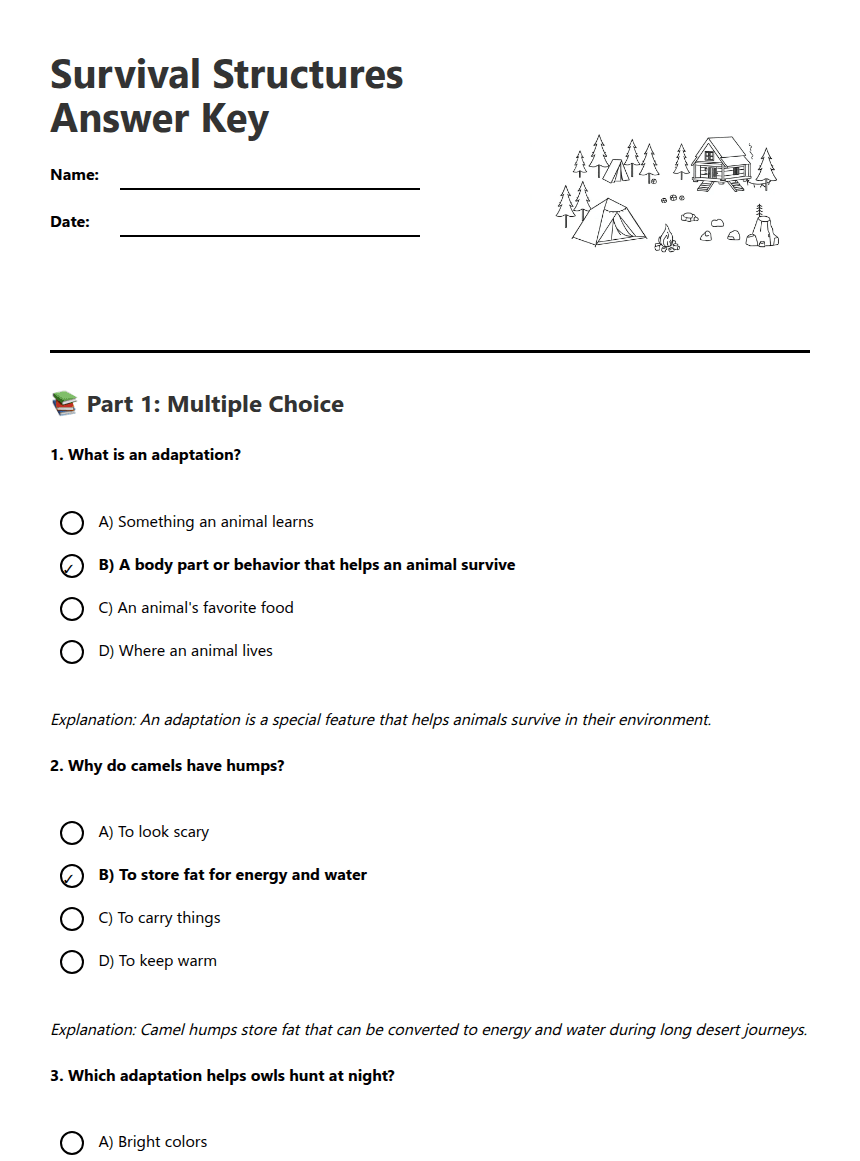
Explanation: An adaptation is a special feature that helps animals survive in their environment.
Explanation: Camel humps store fat that can be converted to energy and water during long desert journeys.
Explanation: Owls have large eyes to see in darkness and special feathers for silent flight to surprise prey.
Explanation: Thick fur, fat layers, and small extremities help animals stay warm. Large ears actually help animals cool down.
🔗 Part 2: Matching Activity
Answer Key:
Polar Bear → Thick white fur for warmth and camouflage
Chameleon → Color-changing skin for camouflage
Kangaroo Rat → Gets water from food, doesn't need to drink
Poison Dart Frog → Bright colors warn predators of poison
✏️ Part 3: Short Answer Questions
Sample Answer: A giraffe's long neck helps it reach leaves high up in trees that other animals cannot reach. This gives giraffes access to food that others don't have, helping them survive when food is scarce.
Sample Answer: Structural adaptation: Sharp talons for grabbing prey. Sensory adaptation: Excellent eyesight to spot prey from far away.
Answer: Animals that live in the Arctic/cold often have thick fur/fat to keep warm, while animals in the desert might have large ears to stay cool.
Sample Answer: This pattern shows how a body part (structure) does a specific job (function) that helps the animal survive (survival benefit). Example: A duck's webbed feet (structure) help it swim well (function) so it can escape predators and find food in water (survival benefit).
About This Worksheet
Free in Kuraplan
Sign up free, grab the PDF, and customize it for your class.
Print-Ready
Formatted for standard paper. Clean layout, easy to read.
AI-Generated
Created with Kuraplan's AI, designed for real classroom use.
For Teachers & Parents
Use in classrooms, for homework, tutoring, or homeschool.
Need a custom version of this worksheet?
Kuraplan's AI generates custom worksheets in seconds — differentiated for every learner, aligned to your curriculum.
Generate Custom Worksheets — FreeMore Science Worksheets
Variables in Science Investigations
Free
Forensic Science Word Search
Free
Science Observation Recording Sheet
Free
Science Objects Exploration
Free
Sports Science Introduction
Free
Senior Social Science Icebreaker
Free
What is Science?
Free