How Ears Detect Sound
A free science worksheet ready for your classroom. Open in Kuraplan to grab the print-ready PDF, customize it for your students, or generate a fresh version in seconds.
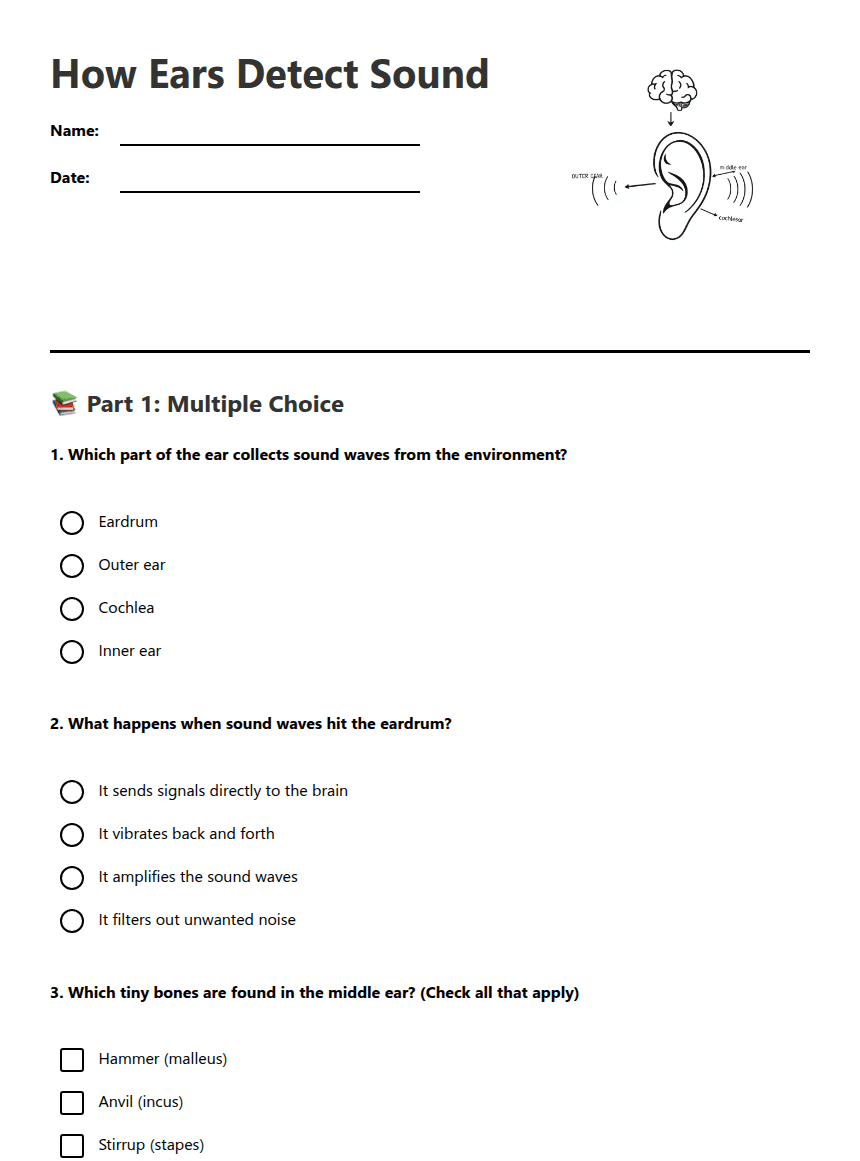
How Ears Detect Sound
📚 Part 1: Multiple Choice
✏️ Part 2: Short Answer Questions
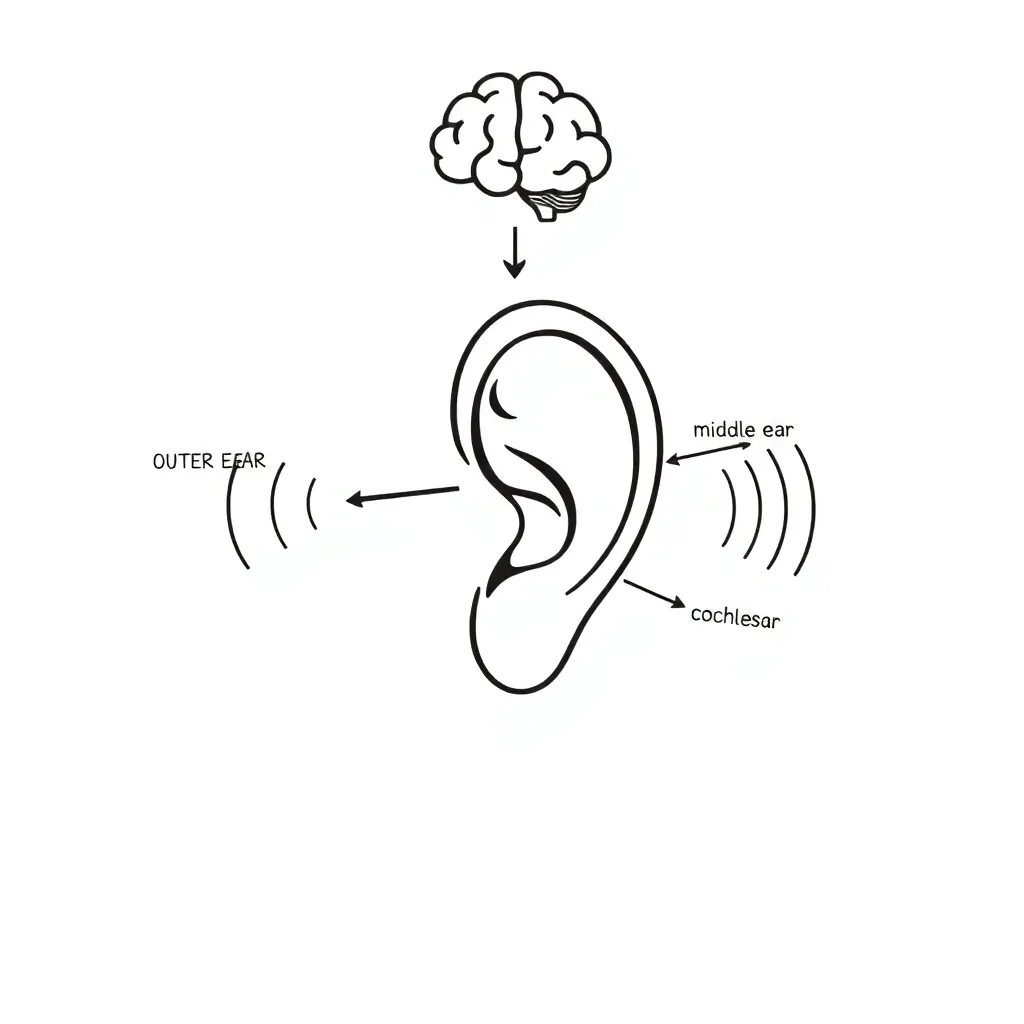
🎨 Part 3: Diagram Labeling
Sound waves → _____________ → Eardrum vibrates → _____________ amplify vibrations → Cochlea converts vibrations to _____________ → _____________ carries signals to brain → Brain interprets sound
🔑 Answer Key
1. Outer ear - The outer ear (pinna) collects and funnels sound waves into the ear canal.
2. It vibrates back and forth - The eardrum vibrates when sound waves strike it, transferring the energy to the middle ear bones.
3. Hammer (malleus), Anvil (incus), Stirrup (stapes) - These are the three tiny bones in the middle ear. The cochlea is part of the inner ear.
4. Fluid - The cochlea is filled with fluid that helps transmit vibrations to the hair cells.
5. Electrical signals - Hair cells convert mechanical vibrations into electrical signals that the brain can interpret.
6. Sound waves enter the outer ear and travel through the ear canal to the eardrum. The eardrum vibrates and moves the middle ear bones (hammer, anvil, stirrup), which amplify the vibrations. These vibrations enter the fluid-filled cochlea, where hair cells convert them into electrical signals. The auditory nerve carries these signals to the brain, where they are interpreted as sound.
7. The three tiny bones (hammer, anvil, stirrup) amplify sound vibrations from the eardrum and transfer them efficiently to the inner ear. They act like a lever system that increases the force of vibrations, making quiet sounds loud enough for the inner ear to detect.
8. If hair cells in the cochlea were damaged, hearing would be impaired or lost. Hair cells are responsible for converting sound vibrations into electrical signals. Damaged hair cells cannot regenerate in humans, so this would result in permanent hearing loss for the frequencies those particular hair cells were responsible for detecting.
9. Diagram should include: outer ear (pinna), ear canal, eardrum, hammer, anvil, stirrup, cochlea, and auditory nerve, with proper positioning showing the path from outer to inner ear.
10. Sound waves → Outer ear/ear canal → Eardrum vibrates → Middle ear bones amplify vibrations → Cochlea converts vibrations to electrical signals → Auditory nerve carries signals to brain → Brain interprets sound
About This Worksheet
Free in Kuraplan
Sign up free, grab the PDF, and customize it for your class.
Print-Ready
Formatted for standard paper. Clean layout, easy to read.
AI-Generated
Created with Kuraplan's AI, designed for real classroom use.
For Teachers & Parents
Use in classrooms, for homework, tutoring, or homeschool.
Need a custom version of this worksheet?
Kuraplan's AI generates custom worksheets in seconds — differentiated for every learner, aligned to your curriculum.
Generate Custom Worksheets — FreeMore Science Worksheets
Variables in Science Investigations
Free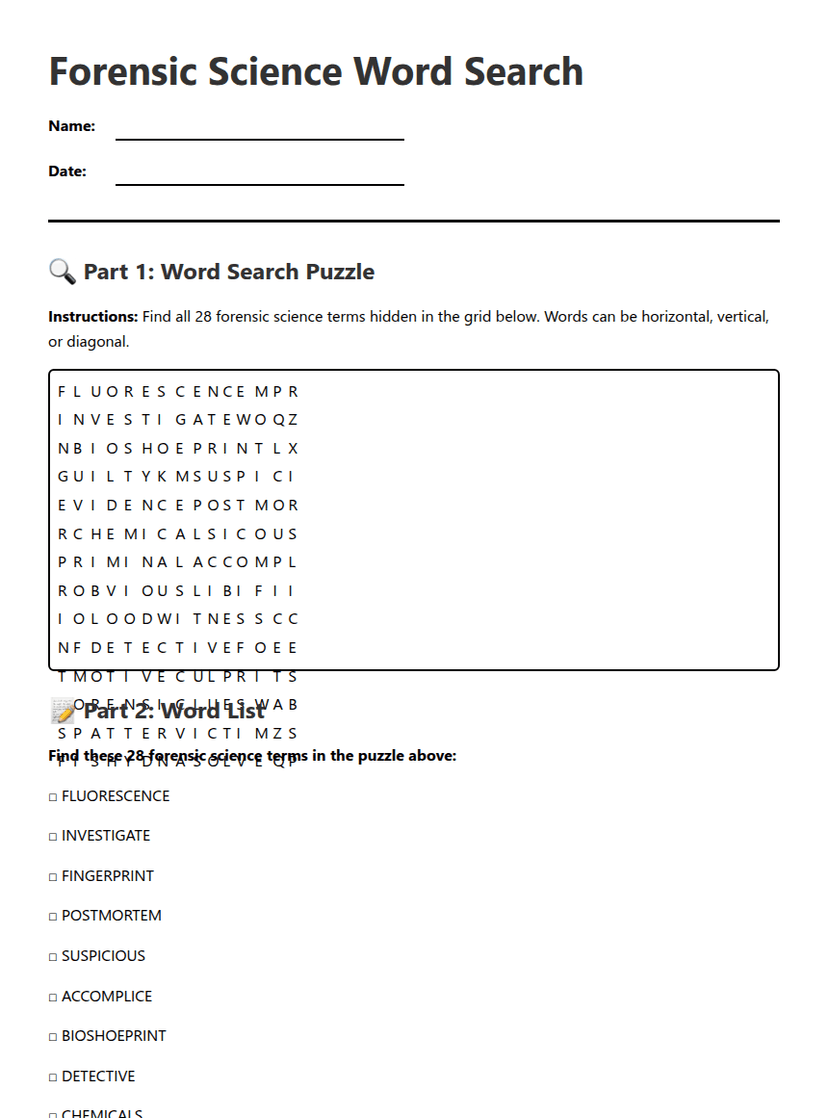
Forensic Science Word Search
Free
Science Observation Recording Sheet
Free
Science Objects Exploration
Free
Sports Science Introduction
Free
Senior Social Science Icebreaker
Free
What is Science?
Free