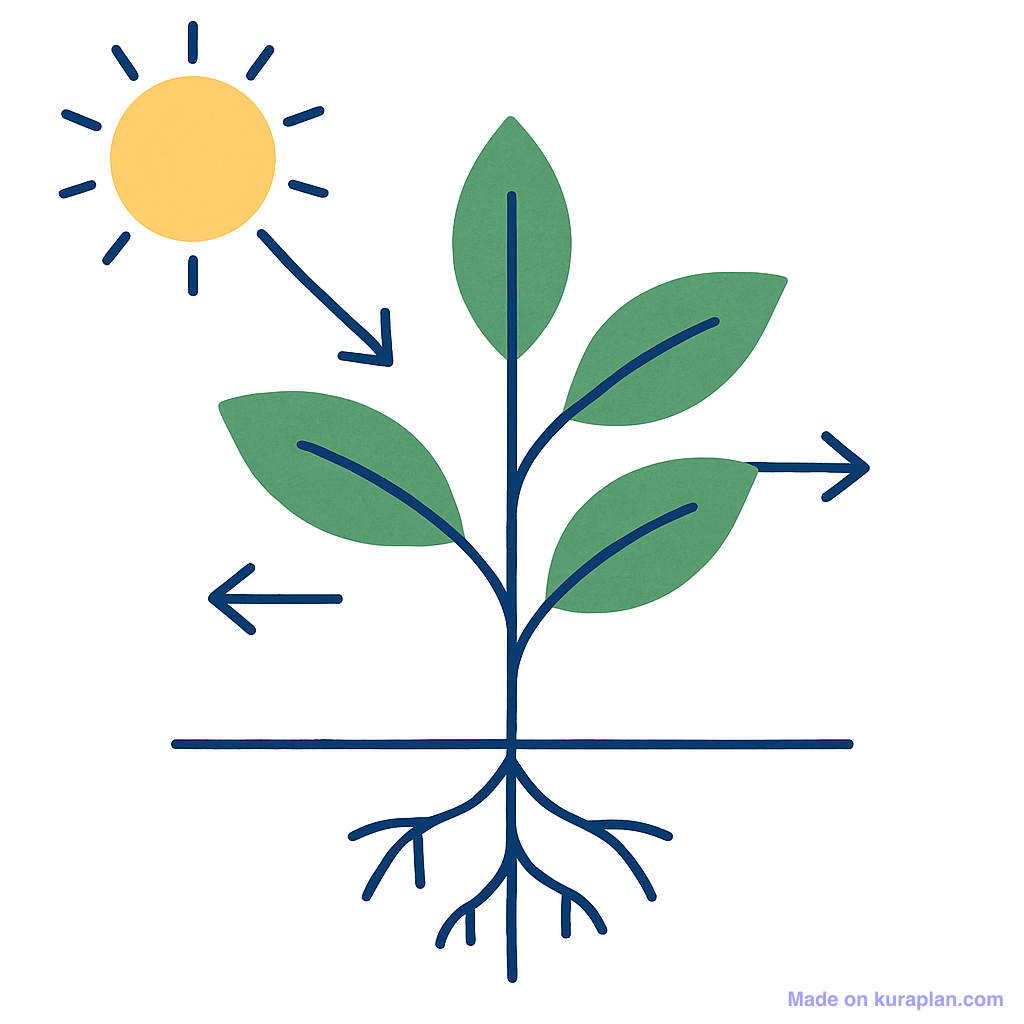
How Plants Turn Light Into Food
Understanding Photosynthesis Year 9 Biology The Amazing Process That Powers Life on Earth

What Do Plants Need to Survive?
Think about what you observe plants doing What do they take in from their environment? What do they produce or give off?

The Photosynthesis Equation
6CO₂ + 6H₂O + light energy → C₆H₁₂O₆ + 6O₂ Carbon dioxide + Water + Light → Glucose + Oxygen Plants use sunlight to combine simple molecules into food

Where Does Photosynthesis Happen?
Occurs mainly in leaves Chloroplasts are the 'factories' Chlorophyll captures light energy Stomata allow gas exchange

The Two Stages of Photosynthesis
{"left":"Light-dependent reactions\nOccur in thylakoids\nCapture light energy\nSplit water molecules\nProduce ATP and NADPH","right":"Light-independent reactions (Calvin Cycle)\nOccur in stroma\nUse ATP and NADPH\nFix carbon dioxide\nProduce glucose"}

Investigating Light and Photosynthesis
Place aquatic plants in different light conditions Count oxygen bubbles produced Record results in a table What happens in bright vs dim light?

Factors Affecting Photosynthesis Rate
Light intensity - more light, faster rate Carbon dioxide concentration - needed as raw material Temperature - affects enzyme activity Water availability - essential reactant

The Foundation of Life
Almost all life on Earth depends on photosynthesis Plants convert 100 billion tonnes of CO₂ annually Photosynthesis produces all the oxygen we breathe

From Sunlight to Food Chain

Summary: How Plants Turn Light Into Food
Plants capture light energy using chlorophyll They combine CO₂ and H₂O to make glucose Oxygen is released as a waste product This process feeds all life on Earth Understanding photosynthesis helps us appreciate our dependence on plants
More Photosynthesis slide decks
Other ready-to-teach decks on photosynthesis.

Free Photosynthesis images
Drop these illustrations straight into your lesson.