Elastic Collisions: Momentum in Motion
Year 11 Physics Understanding Conservation Laws in Motion
Learning Objectives
Define momentum and understand its vector nature Explain the principle of conservation of momentum Distinguish between elastic and inelastic collisions Apply conservation laws to solve collision problems Analyse real-world collision scenarios
What is Momentum?
Momentum = mass × velocity (p = mv) Momentum is a vector quantity Units: kg⋅m/s or N⋅s Depends on both mass and velocity More massive or faster objects have greater momentum
Think About It
Which has more momentum: A 1000 kg car travelling at 30 m/s OR A 2000 kg truck travelling at 10 m/s?

Newton's Third Law and Momentum
For every action, there is an equal and opposite reaction Forces always occur in pairs These force pairs act for the same time duration This leads to conservation of momentum Internal forces cannot change total momentum
Conservation of Momentum
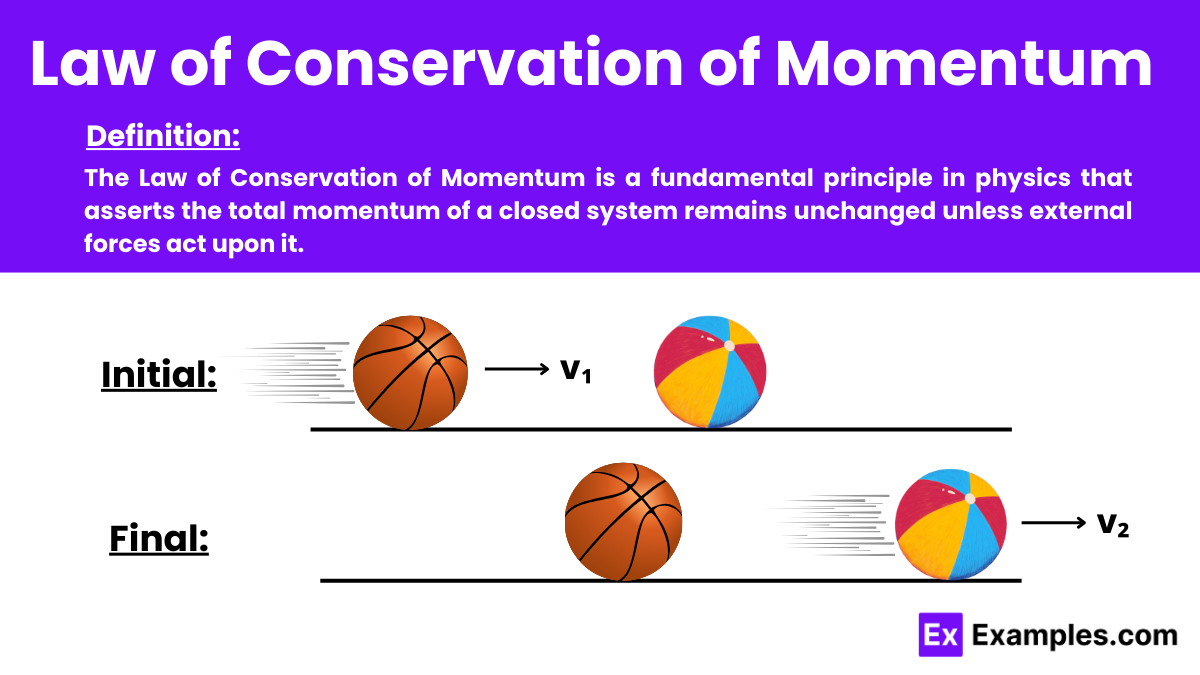
Total momentum before collision = Total momentum after collision Applies to all collisions in isolated systems No external forces acting on the system Mathematical expression: Σp(before) = Σp(after) One of the most fundamental laws in physics

Types of Collisions
{"left":"Elastic Collisions\nKinetic energy is conserved\nObjects bounce apart\nNo permanent deformation\nExamples: billiard balls, atomic particles","right":"Inelastic Collisions\nKinetic energy is not conserved\nObjects may stick together\nEnergy converted to heat, sound, deformation\nExamples: car crashes, clay balls"}
Collision Investigation
Use the simulation or demonstration apparatus Observe elastic collisions between identical masses Record velocities before and after collision Calculate momentum and kinetic energy Verify conservation laws
Elastic Collision: Equal Masses
When two identical objects collide elastically Moving object transfers all momentum to stationary object Moving object stops completely Stationary object moves off with original velocity Perfect momentum and energy transfer

Mathematical Analysis: Equal Masses
Before collision: m₁v₁ + m₂(0) = mv₁ After collision: m₁(0) + m₂v₂ = mv₂ Conservation of momentum: mv₁ = mv₂ Therefore: v₂ = v₁ The velocities are simply exchanged

Quick Check
A 2 kg ball moving at 5 m/s collides elastically with an identical stationary ball. What are the final velocities?

Elastic Collision: Different Masses
More complex momentum transfer Both objects typically move after collision Lighter object bounces back if hit by heavier object Heavier object continues forward but slows down Requires solving simultaneous equations
8 more slides available after you open the deck.
Download all 20 slides