Religious EducationFreePrintable

Māori Spirituality Community Study

A free religious education worksheet ready for your classroom. Open in Kuraplan to grab the print-ready PDF, customize it for your students, or generate a fresh version in seconds.
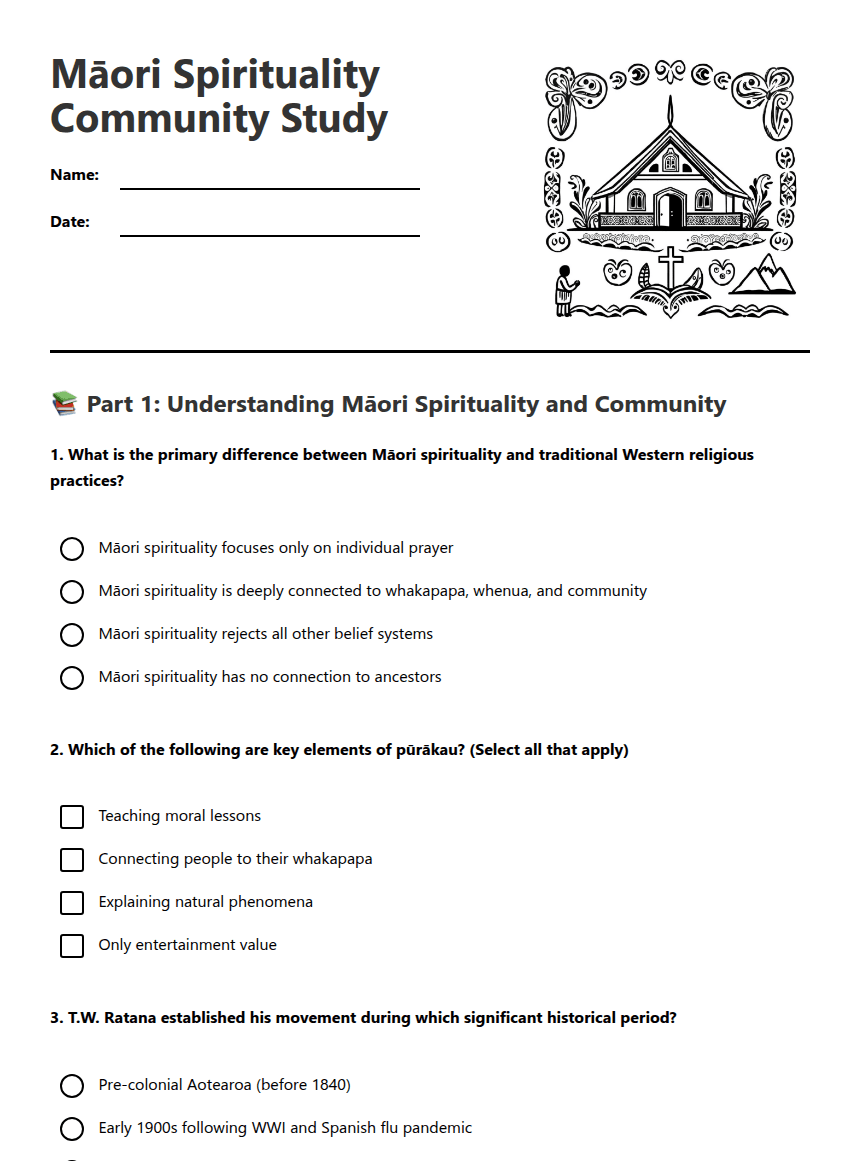
Māori Spirituality Community Study worksheet preview
Māori Spirituality Community Study

Māori spiritual symbols and community

📚 Part 1: Understanding Māori Spirituality and Community

1. What is the primary difference between Māori spirituality and traditional Western religious practices?

Māori spirituality focuses only on individual prayer

Māori spirituality is deeply connected to whakapapa, whenua, and community

Māori spirituality rejects all other belief systems

Māori spirituality has no connection to ancestors

2. Which of the following are key elements of pūrākau? (Select all that apply)

Teaching moral lessons

Connecting people to their whakapapa

Explaining natural phenomena

Only entertainment value

3. T.W. Ratana established his movement during which significant historical period?

Pre-colonial Aotearoa (before 1840)

Early 1900s following WWI and Spanish flu pandemic

During the New Zealand Wars (1860s)

The 1980s Māori renaissance

4. The Ratana movement can be described as syncretic because it:

Completely rejects Christian beliefs

Combines Christian theology with Māori spiritual traditions

Only follows traditional Māori practices

Has no political involvement

✏️ Part 2: Community Case Study Analysis

5. Explain how the historical context of land loss and post-WWI disillusionment influenced the development of the Ratana movement. Include specific examples.
6. Describe the significance of te whetū Mārama (the morning star) as a symbol within the Ratana community and how it connects to their beliefs.
7. Fill in the blanks about Ratana beliefs:

The Ratana movement recognises the _____________ as central to their faith, while T.W. Ratana was seen as a _____________ (messenger) of God. The movement also acknowledges _____________ who assist in spiritual matters, showing the blend of Christian and Māori spiritual concepts.

8. How do the key narratives of the Bible and Te Tiriti o Waitangi work together in Ratana theology? Explain their complementary roles.

🔍 Part 3: Research and Reflection Activity

9. Choose ONE aspect of the Ratana community to investigate further (e.g., their healing practices, political influence, modern-day activities, or specific rituals). Write a brief research plan including what sources you would use and what questions you want to answer.
10. Reflection: How does studying the Ratana community help us understand the broader theme of how religious and spiritual communities adapt to changing social and historical contexts? Give specific examples.

Achievement Standards Focus:

AS91916: Explore how beliefs, practices and narratives are expressed by a religious or spiritual community

AS91917: Explore a significant religious or spiritual narrative

Learning Goal: To understand how Māori spiritual communities like Ratana developed in response to historical contexts and how they blend traditional and introduced religious elements.

About This Worksheet

Free in Kuraplan

Sign up free, grab the PDF, and customize it for your class.

Print-Ready

Formatted for standard paper. Clean layout, easy to read.

AI-Generated

Created with Kuraplan's AI, designed for real classroom use.

For Teachers & Parents

Use in classrooms, for homework, tutoring, or homeschool.

Need a custom version of this worksheet?

Kuraplan's AI generates custom worksheets in seconds — differentiated for every learner, aligned to your curriculum.

Generate Custom Worksheets — Free
No credit card Curriculum-aligned Under 60 seconds